Building a Voice of Customer Program That Actually Influences Roadmap
Learn how to systematically collect, organize, and present user feedback so product decisions are data-driven. Includes stakeholder buy-in strategies.
Summary
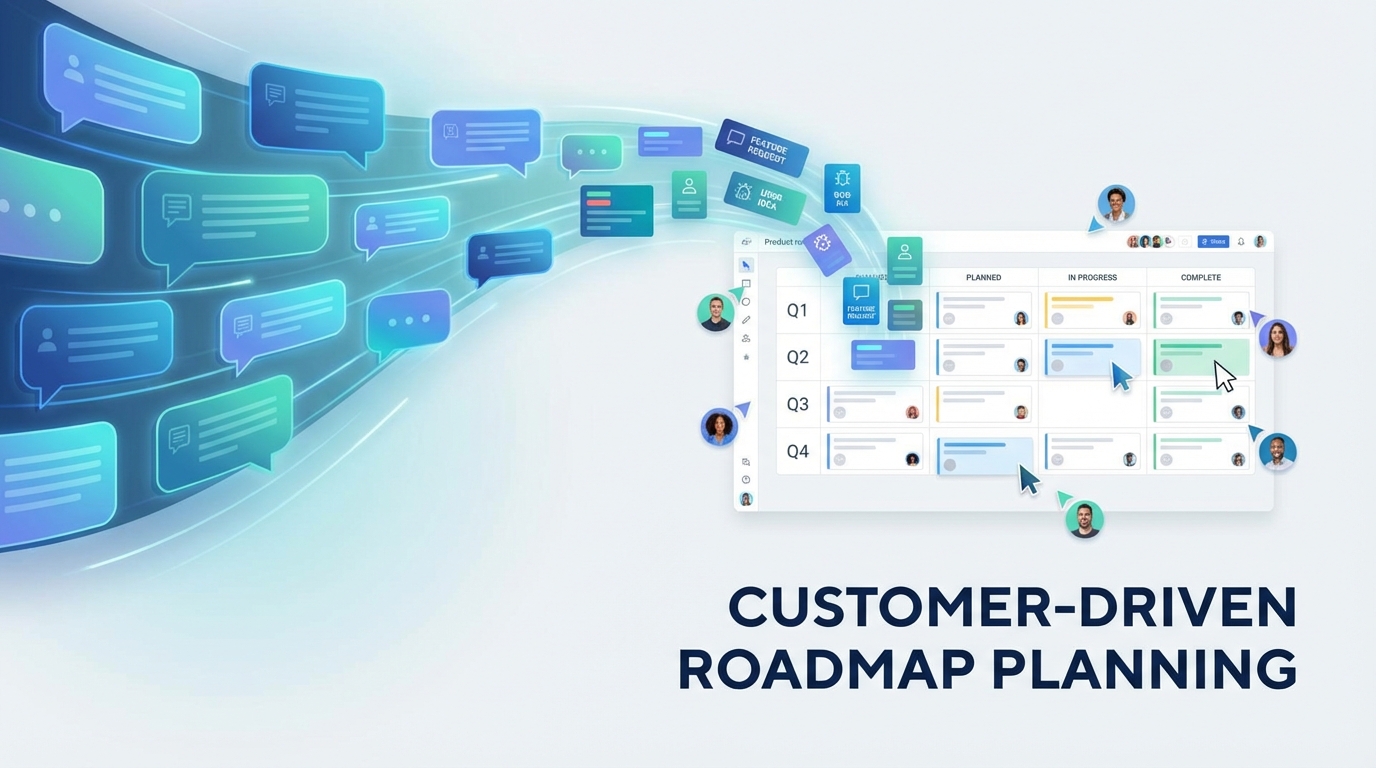
Most companies collect feedback but fail to influence product decisions with it. A successful Voice of Customer (VoC) program requires more than surveys—it needs systematic collection, intelligent organization, compelling presentation, and stakeholder buy-in. This guide shows how to build a VoC program that actually shapes your roadmap.
The VoC Failure Pattern
Companies invest in feedback tools but see no change in how decisions get made. The pattern is predictable:
- Collection happens: Surveys deployed, widgets installed, tickets logged
- Data accumulates: Spreadsheets fill, tools populate, reports generate
- Nothing changes: Roadmap decisions still made by HiPPO (Highest Paid Person's Opinion)
- Cynicism grows: Teams stop believing feedback matters
- Collection declines: Why bother if nothing changes?
The problem isn't collection—it's everything that happens after.
Why Feedback Gets Ignored
Product leaders don't ignore feedback maliciously. They ignore it because:
It's overwhelming: Thousands of pieces without synthesis It's unstructured: Free text without categorization It conflicts: Users want opposite things It lacks context: Who said this? How important are they? It competes: With stakeholder requests, technical debt, strategic initiatives
Effective VoC programs solve these problems.
The Four Pillars of VoC Programs
A VoC program that influences decisions rests on four pillars.
Pillar 1: Systematic Collection
Random feedback collection creates random insights. Systematic collection ensures comprehensive coverage.
Coverage dimensions:
| Dimension | Collection Methods |
|---|---|
| Journey stage | Stage-specific triggers (onboarding, activation, renewal) |
| User segment | Segment-targeted surveys, interview quotas |
| Feedback type | Bug reports, feature requests, satisfaction, churn reasons |
| Channel | In-app, email, support, sales, social |
Collection cadence:
| Feedback Type | Frequency | Method |
|---|---|---|
| Transactional (post-action) | Continuous | In-app triggers |
| Relationship (overall satisfaction) | Quarterly | Email surveys |
| Deep qualitative | Monthly | User interviews |
| Passive (behavioral) | Continuous | Usage analytics |
Pillar 2: Intelligent Organization
Raw feedback is noise. Organized feedback is signal.
Categorization framework:
Level 1: Type
├── Feature Request
├── Bug Report
├── Usability Issue
├── Documentation Gap
└── General Feedback

Level 2: Product Area
├── Core Feature A
├── Core Feature B
├── Integration
├── Admin/Settings
└── Billing

Level 3: Theme
├── Speed/Performance
├── Ease of Use
├── Missing Capability
├── Reliability
└── Price/Value
AI-powered tagging:
- Auto-categorize incoming feedback
- Extract themes from free text
- Identify sentiment and urgency
- Link related items
User context attachment: Every feedback item should carry:
- User ID and account
- Segment (plan, size, industry)
- Lifetime value
- Tenure
- Health score
Pillar 3: Compelling Presentation
Data doesn't speak for itself. Presentation determines influence.
The VoC Dashboard:
┌─────────────────────────────────────────────────────────────┐
│  Voice of Customer Dashboard                    [Date Range]│
├─────────────────────────────────────────────────────────────┤
│                                                             │
│  Top Requested Features          │  Sentiment Trend         │
│  ┌───────────────────────────┐   │  ┌──────────────────┐    │
│  │ 1. API webhooks (47)      │   │  │ ████████████     │    │
│  │ 2. Dark mode (38)         │   │  │ ▲ 12% this month │    │
│  │ 3. Export to CSV (31)     │   │  └──────────────────┘    │
│  │ 4. SSO support (28)       │   │                          │
│  │ 5. Mobile app (24)        │   │  NPS: 47 → 52            │
│  └───────────────────────────┘   │  CSAT: 4.2 → 4.4         │
│                                                             │
│  Feedback by Segment             │  Recent Themes           │
│  ┌───────────────────────────┐   │  ┌──────────────────┐    │
│  │ Enterprise: 234 items     │   │  │ Performance (↑)  │    │
│  │ Pro: 567 items            │   │  │ Onboarding (↓)   │    │
│  │ Free: 891 items           │   │  │ Integrations (→) │    │
│  └───────────────────────────┘   │  └──────────────────┘    │
│                                                             │
└─────────────────────────────────────────────────────────────┘
Narrative reports:
Dashboards show data. Reports tell stories. Monthly VoC reports should include:
- Executive summary: 3 bullets on what matters this month
- Quantitative trends: Volume, sentiment, category shifts
- Qualitative highlights: Specific quotes that illustrate themes
- Recommendations: What product should consider
Pillar 4: Stakeholder Buy-In
The best data presentation fails without organizational buy-in.
Building credibility:
- Start with quick wins (act on obvious insights)
- Document when VoC-driven changes succeed
- Build case studies of feedback → decision → outcome
Creating accountability:
- Include VoC review in roadmap planning rituals
- Require "customer evidence" for roadmap items
- Track percentage of roadmap informed by VoC
Managing resistance:
- Address "but customers don't know what they want" (Jobs-to-Be-Done framing)
- Handle conflicting feedback transparently
- Acknowledge VoC as input, not dictation
Building Your Collection Infrastructure
Practical implementation of systematic collection.
In-App Feedback Channels
Persistent feedback button:
// Always-available feedback entry point
<FeedbackWidget
  trigger="floating-button"
  position="bottom-right"
  types={['bug', 'feature', 'general']}
  contextCapture={true}
/>
Contextual prompts:
// Trigger after specific actions
if (user.completedFirstExport) {
  showFeedbackPrompt({
    question: "How was your first export experience?",
    type: 'rating',
    followUp: 'What would have made it better?',
  });
}
Exit-intent capture:
// Capture feedback when users show leaving signals
onExitIntent(() => {
  showFeedbackPrompt({
    question: "Before you go—anything we could improve?",
    type: 'open',
    priority: 'low-friction',
  });
});
Email Feedback Programs
Relationship surveys (quarterly):
- Net Promoter Score with follow-up
- Feature satisfaction matrix
- Open feedback invitation
Transactional surveys (event-triggered):
- Post-onboarding (day 7)
- Post-support resolution
- Post-renewal
- Post-major feature use
Interview Programs
Continuous interview program:
- Target: 4-8 interviews per month
- Rotating focus areas
- Mix of segments and tenure
- Recorded and transcribed
Interview question framework:
- Context: Role, goals, how they found you
- Usage: How they use the product, workflows
- Value: What problems it solves, outcomes achieved
- Friction: What's hard, what's missing, frustrations
- Alternatives: What else they've tried or considered
- Future: What would make them use it more
AI-Powered Analysis
Manual analysis doesn't scale. AI transforms raw feedback into insights.
Automated Categorization
AI reads incoming feedback and assigns:
- Primary category and subcategory
- Product area affected
- Sentiment score
- Urgency level
- Potential impact
Accuracy expectations:
| Task | Expected Accuracy |
|---|---|
| Category assignment | 85-90% |
| Sentiment detection | 90-95% |
| Theme extraction | 80-85% |
| Urgency assessment | 75-80% |
Human review of edge cases and periodic calibration maintains quality.
Theme Clustering
AI identifies emerging themes without predefined categories:
Input: 500 feedback items about "reporting"
Output:
- Cluster 1: Export format requests (CSV, Excel, PDF) - 45%
- Cluster 2: Scheduling/automation needs - 25%
- Cluster 3: Visualization improvements - 20%
- Cluster 4: Performance complaints - 10%
Clustering reveals sub-themes humans might miss or categorize inconsistently.
Trend Detection
AI monitors for significant changes:
Alert conditions:
- Sudden spike in category volume
- Sentiment shift in segment
- New theme emerging
- Keyword frequency changes
Example alert:
"⚠️ 340% increase in feedback mentioning 'slow' in the past 7 days, concentrated in Enterprise segment. Possible performance regression."
Impact Estimation
AI estimates business impact of addressing feedback:
Impact Score = (
  Request Frequency ×
  Segment Value Weight ×
  Churn Correlation ×
  Implementation Complexity Inverse
)
This creates a prioritized list that balances customer voice with business reality.
Presenting to Stakeholders
How you present VoC data determines whether it influences decisions.
The Monthly VoC Review
Attendees: Product, Engineering leads, Customer Success, Executive sponsor
Agenda (30 minutes):
- Volume and sentiment trends (5 min)
- Top themes with evidence (10 min)
- Spotlight: Deep dive on one theme (10 min)
- Recommendations and discussion (5 min)
Materials:
- Dashboard link for self-serve exploration
- Written summary for async readers
- Specific customer quotes for emotional resonance
Connecting Feedback to Roadmap
Before roadmap planning: Prepare a "customer evidence brief" for each potential initiative:
- Number of requests
- Segments requesting
- Sample quotes
- Competitive context
- Estimated impact
During roadmap planning:
- Require customer evidence for prioritization discussions
- Flag items with zero customer signal
- Surface unexpected high-volume requests
After roadmap decisions:
- Document which items were VoC-influenced
- Track roadmap percentage informed by customer feedback
- Plan communication back to customers
Handling Conflicting Feedback
Users want contradictory things. Handle this transparently:
Acknowledge the conflict:
"We're seeing split feedback on X. Some users want A (42%), others want B (38%), and some want neither (20%)."
Segment the conflict:
"Enterprise users strongly prefer A, while SMB users prefer B. This aligns with their different use cases."
Provide recommendation:
"Given our strategic focus on Enterprise, we recommend A, with B considered for a future SMB-focused initiative."
Measuring VoC Program Success
Track whether your program actually influences decisions.
Process Metrics
| Metric | Target | Why It Matters |
|---|---|---|
| Collection coverage | 80% of journey stages | Comprehensive input |
| Categorization accuracy | 85%+ | Reliable organization |
| Response rate | 20%+ | Sufficient volume |
| Time to synthesis | < 1 week | Timely insights |
Influence Metrics
| Metric | Target | Why It Matters |
|---|---|---|
| Roadmap items with customer evidence | 60%+ | VoC integration |
| Stakeholder engagement with VoC reports | 80% open rate | Visibility |
| Decisions citing VoC data | Increasing | Actual influence |
| Time from feedback to action | Decreasing | Responsiveness |
Outcome Metrics
| Metric | Why It Matters |
|---|---|
| Feature adoption when VoC-informed | Validates that VoC improves decisions |
| Retention in VoC-addressed segments | Proves business impact |
| Satisfaction with addressed issues | Closes the loop |
Key Takeaways
-
Collection alone isn't a program: Without organization, presentation, and buy-in, feedback accumulates without influencing decisions.
-
Systematic beats random: Cover all journey stages, segments, and feedback types through intentional collection design.
-
AI enables scale: Automated categorization, theme clustering, and trend detection transform overwhelming volume into actionable insights.
-
Presentation determines influence: Dashboards show data, but narratives and recommendations drive decisions.
-
Buy-in requires proof: Build credibility through quick wins and documented successes before expecting organizational change.
-
Connect VoC to roadmap rituals: Require customer evidence in planning, track VoC-influenced percentage, and communicate outcomes.
-
Measure program effectiveness: Track both process metrics (collection, categorization) and influence metrics (decisions citing VoC).
User Vibes OS provides the infrastructure for Voice of Customer programs—from collection through AI analysis to stakeholder reporting. Learn more.
Related Articles
The User Journey Lifecycle: A Framework for Continuous Feedback
Discover the 9-stage user journey lifecycle for collecting feedback from attract to recapture. Build products users love with continuous insights.
Real-Time Sentiment Dashboards for Product Teams
Build dashboards that show user mood as it happens, not weeks later in reports. Monitor sentiment at scale and respond before problems escalate.
User Journey Mapping: Strategic Feedback Touchpoints
Learn where to place feedback collection across the user lifecycle for maximum insight with minimum friction. A systematic approach to journey-based feedback.
Written by User Vibes OS Team
Published on January 12, 2026