The User Journey Lifecycle: A Framework for Continuous Feedback
Discover the 9-stage user journey lifecycle for collecting feedback from attract to recapture. Build products users love with continuous insights.
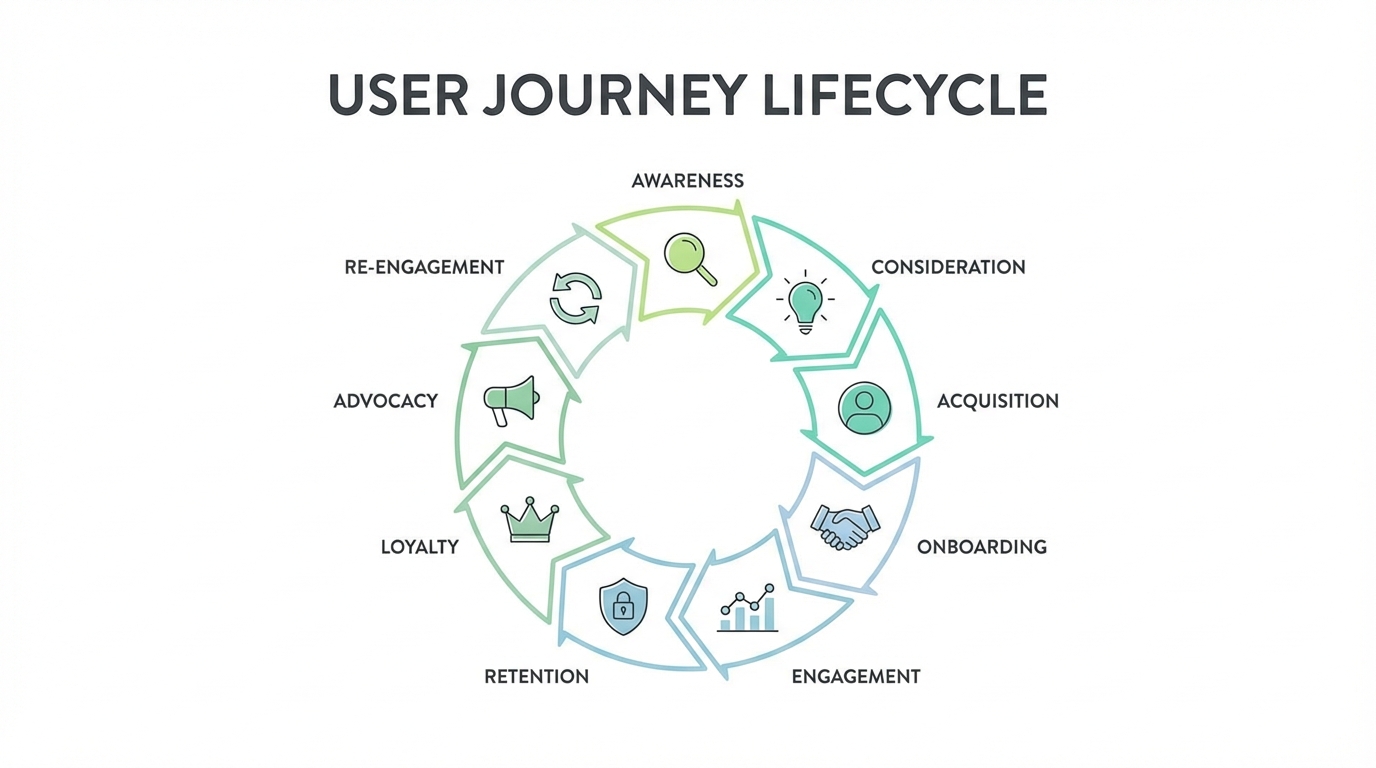
Summary
Most companies collect feedback at one or two touchpoints—usually when something goes wrong. The user journey lifecycle framework provides nine stages for continuous feedback collection: Attract, Qualify, Anticipate, Nurture, Alert, Ideate, Resolve, Measure, Amplify, and Recapture. This comprehensive approach yields dramatically better insights than point-in-time surveys.
Beyond Point-in-Time Feedback
Traditional feedback collection is episodic. You send an NPS survey quarterly. You add a feedback widget after support tickets. You run a user research session when planning a major feature.
These moments capture snapshots, but users' relationships with your product evolve continuously. The frustration that causes churn builds over weeks. The delight that creates advocates emerges through repeated positive experiences. Point-in-time surveys miss this evolution.
The Lifecycle Advantage
Continuous feedback collection across the user journey provides:
- Early warning signals: Detect problems while they're still fixable
- Contextual insights: Understand feedback in the context of what users were doing
- Trend visibility: See how sentiment evolves over time
- Complete picture: Connect acquisition insights to retention outcomes
The Nine Stages of User Journey Feedback
Each stage in the user journey presents unique opportunities to understand users better. Here's how to leverage each one.
Stage 1: Attract
What happens: Potential users discover your product through marketing, referrals, or search.
Feedback opportunity: Understanding what attracted them tells you what's working and what messages resonate.
Key questions:
- How did you hear about us?
- What problem are you trying to solve?
- What alternatives have you considered?
- What would success look like for you?
Collection method: Landing page micro-surveys, chat widgets, intent capture forms.
Why it matters: Acquisition feedback informs marketing spend and messaging. If users attracted by "ease of use" messaging churn because the product is complex, you've identified a positioning problem early.
Stage 2: Qualify
What happens: Interested users evaluate whether your product fits their needs.
Feedback opportunity: Learning what qualifies or disqualifies prospects improves both product and positioning.
Key questions:
- What features are must-haves for your decision?
- What concerns do you have about switching?
- Who else is involved in this decision?
- What timeline are you working with?
Collection method: Interactive qualification surveys, demo feedback, trial signup questionnaires.
Why it matters: Qualification feedback helps you focus on the right prospects and understand why others don't convert. Both insights are valuable.
Stage 3: Anticipate
What happens: Qualified prospects wait for access, onboarding, or implementation.
Feedback opportunity: The waiting period reveals expectations and anxieties you can address proactively.
Key questions:
- What are you most excited to try first?
- What questions do you have before getting started?
- What would make your first week successful?
- Have your needs changed since signing up?
Collection method: Waitlist engagement emails, pre-onboarding surveys, expectation-setting conversations.
Why it matters: Anticipation feedback lets you customize onboarding and set realistic expectations. Users who start with misaligned expectations often churn regardless of product quality.
Stage 4: Nurture
What happens: Active users develop their relationship with your product over time.
Feedback opportunity: Ongoing nurture reveals how users evolve from novices to power users—or get stuck along the way.
Key questions:
- What features have you discovered recently?
- What are you still trying to figure out?
- How has your usage changed over time?
- What would help you get more value?
Collection method: In-app prompts at milestones, usage-triggered check-ins, educational content feedback.
Why it matters: Nurture feedback identifies where users plateau and what triggers advancement. This informs both product development and success interventions.
Stage 5: Alert
What happens: Your systems detect potential problems before users complain.
Feedback opportunity: Proactive alerts let you investigate issues and gather context before they escalate.
Key questions:
- We noticed you haven't logged in recently—is everything okay?
- Your usage dropped after the last update—did something change?
- You seem to be retrying this action—are you running into trouble?
- Your team's adoption has stalled—what would help?
Collection method: Behavioral trigger emails, proactive support outreach, health score follow-ups.
Why it matters: Alert-based feedback catches problems when they're still salvageable. Users who hear "we noticed something might be wrong" feel cared for rather than surveilled.
Stage 6: Ideate
What happens: Users have ideas for new features, improvements, or use cases.
Feedback opportunity: Feature requests reveal unmet needs and expansion opportunities.
Key questions:
- What job were you trying to do when you thought of this?
- How are you handling this need currently?
- How important is this to your workflow?
- Who else on your team would benefit?
Collection method: Feature request widgets, idea voting boards, conversational AI feedback collection.
Why it matters: Ideation feedback done right captures not just what users want but why they want it. The "why" is often more valuable than the "what."
Stage 7: Resolve
What happens: Users encounter problems, bugs, or confusion that need resolution.
Feedback opportunity: Bug reports and support requests contain rich information about product gaps.
Key questions:
- What were you trying to accomplish when this happened?
- What did you expect to happen?
- How is this affecting your work?
- What would a good resolution look like?
Collection method: Bug report widgets, support ticket enrichment, resolution feedback surveys.
Why it matters: Resolution feedback transforms support from a cost center into a product intelligence source. Patterns in support requests reveal systemic issues.
Stage 8: Measure
What happens: You systematically assess user satisfaction and product health.
Feedback opportunity: Structured measurement provides benchmarks and trend data.
Key questions:
- How likely are you to recommend us? (NPS)
- How easy was it to accomplish your goal? (CES)
- How satisfied are you with [specific feature]? (CSAT)
- What's the one thing you'd change?
Collection method: Periodic surveys, in-app satisfaction ratings, relationship health assessments.
Why it matters: Measurement feedback creates the quantitative foundation for comparing segments, tracking trends, and setting goals.
Stage 9: Amplify
What happens: Satisfied users become advocates who refer others and provide social proof.
Feedback opportunity: Understanding what creates advocates lets you replicate success.
Key questions:
- What would you tell a colleague about us?
- What specific outcome are you most proud of?
- Would you be willing to share your story?
- What almost made you give up?
Collection method: Testimonial requests, case study interviews, referral program feedback.
Why it matters: Amplification feedback reveals your product's hero stories—the transformative outcomes that attract similar customers.
Stage 10: Recapture
What happens: Users disengage, downgrade, or cancel.
Feedback opportunity: Exit feedback reveals why users leave and what might win them back.
Key questions:
- What's the primary reason you're leaving?
- What could we have done differently?
- Is there anything that would change your mind?
- Where are you going instead?
Collection method: Cancellation flows, exit interviews, win-back campaign responses.
Why it matters: Recapture feedback is brutally honest. Users who've decided to leave have no reason to be polite. This honesty is valuable.
Connecting the Stages
Individual stage feedback is useful. Connected stage feedback is transformational.
Journey Correlation
Link feedback across stages to understand user evolution:
| User Segment | Attract Feedback | Nurture Feedback | Outcome |
|---|---|---|---|
| Segment A | "Need simple solution" | "Overwhelmed by options" | High churn |
| Segment B | "Need simple solution" | "Found my workflow" | High retention |
| Segment C | "Need powerful tools" | "Not enough features" | Moderate churn |
This correlation reveals that "simple" messaging attracts users who need different onboarding than your default.
Feedback Inheritance
Later-stage feedback should reference earlier-stage context:
Bad: "Rate your satisfaction with our product."
Good: "When you signed up, you mentioned needing [specific goal]. How well are we helping you achieve that?"
Inherited context makes feedback more relevant and shows users you've been listening all along.
Lifecycle Triggers
Use feedback from one stage to trigger actions in another:
- Low NPS score → Proactive support outreach (Alert)
- Feature request spike → Product research interviews (Ideate)
- Cancellation reason patterns → Qualification question updates (Qualify)
- Testimonial enthusiasm → Case study invitation (Amplify)
Implementation Priorities
You can't implement all nine stages simultaneously. Here's a practical sequencing.
Phase 1: Foundation (Weeks 1-4)
Start with the highest-impact stages:
- Resolve: You're probably already handling support. Enhance it with better context capture.
- Measure: Establish baseline metrics with a simple NPS or satisfaction survey.
- Ideate: Add a lightweight feature request mechanism.
Phase 2: Expansion (Months 2-3)
Add proactive stages:
- Alert: Implement behavioral triggers for at-risk users.
- Recapture: Build a proper exit feedback flow.
- Amplify: Begin systematic testimonial collection.
Phase 3: Completion (Months 4-6)
Round out the lifecycle:
- Attract: Add acquisition source and motivation tracking.
- Qualify: Enhance trial/demo feedback collection.
- Anticipate/Nurture: Implement ongoing engagement feedback.
Avoiding Common Pitfalls
Lifecycle feedback collection can go wrong. Avoid these mistakes.
Survey Fatigue
Problem: Users asked for feedback too frequently disengage entirely.
Solution: Coordinate across stages. Use sampling. Make feedback feel valuable, not extractive.
Data Silos
Problem: Each stage's feedback lives in a different tool, preventing correlation.
Solution: Unified feedback platform or intentional integration between tools.
Action Gaps
Problem: Feedback collected but never acted upon erodes user trust.
Solution: Close the loop. Tell users what changed because of their feedback.
Context Loss
Problem: Feedback captured without surrounding context is hard to interpret.
Solution: Always capture who, when, and what was happening alongside the feedback itself.
Key Takeaways
-
Point-in-time feedback misses evolution: Users' relationships with your product change continuously; your feedback collection should too.
-
Nine stages cover the complete journey: From Attract through Recapture, each stage offers unique insight opportunities.
-
Connection multiplies value: Linking feedback across stages reveals patterns invisible in isolated data.
-
Prioritize implementation pragmatically: Start with Resolve, Measure, and Ideate; expand from there.
-
Avoid survey fatigue: Coordinate feedback requests across stages to respect user attention.
-
Close the loop: Tell users what changed because of their feedback to maintain engagement.
-
Context is essential: Capture not just what users say but when and why they said it.
User Vibes OS provides an AI-enhanced platform for collecting feedback across the entire user journey lifecycle. See how it works or start your free trial.
Related Articles
User Journey Mapping: Strategic Feedback Touchpoints
Learn where to place feedback collection across the user lifecycle for maximum insight with minimum friction. A systematic approach to journey-based feedback.
Building a Voice of Customer Program That Actually Influences Roadmap
Learn how to systematically collect, organize, and present user feedback so product decisions are data-driven. Includes stakeholder buy-in strategies.
Real-Time Sentiment Dashboards for Product Teams
Build dashboards that show user mood as it happens, not weeks later in reports. Monitor sentiment at scale and respond before problems escalate.
Written by User Vibes OS Team
Published on January 10, 2026