Turning Happy Users into Advocates: Automating Testimonial Collection
Learn when and how to ask for testimonials, identify your happiest users with AI, and amplify social proof across channels. Convert satisfaction into growth.
Summary
Your happiest users are your most underutilized growth engine. This guide covers how to identify potential advocates using AI-powered satisfaction signals, the optimal timing and methods for requesting testimonials, and strategies for amplifying social proof across your marketing channels. Systematic advocacy programs generate 3-5x more testimonials than ad-hoc requests.
The Untapped Advocacy Goldmine
Somewhere in your user base, people love your product. They've achieved outcomes they're proud of. They'd happily tell others—if you asked. Most companies never ask, or ask at the wrong time, or ask in the wrong way.
Why Advocacy Matters
Social proof drives decisions:
- 92% of consumers trust recommendations from people they know
- 70% trust online reviews from strangers
- Case studies are the most influential content type for B2B buyers
- Testimonials on landing pages increase conversions by 34%
Yet most companies treat testimonial collection as an afterthought—occasional manual requests that yield occasional results.
The Advocacy Gap
The gap between satisfied users and active advocates represents lost growth:
| User Segment | Size | Advocacy Potential | Typically Activated |
|---|---|---|---|
| Highly satisfied | 20-30% | Excellent | 5-10% |
| Satisfied | 40-50% | Good | 2-5% |
| Neutral | 20-30% | Low | < 1% |
| Dissatisfied | 5-15% | None | N/A |
Most of your advocacy potential goes unrealized. Systematic programs close this gap.
Identifying Your Advocates
Not every satisfied user makes a good advocate. Identifying the right users to approach increases success rates dramatically.
Behavioral Signals
Actions predict advocacy potential better than survey responses:
Power usage indicators:
- Feature adoption breadth (using many features)
- Feature adoption depth (using features fully)
- Login frequency and session duration
- Team invitation and expansion
- Upgrade/expansion purchases
Engagement signals:
- Support interactions ending positively
- Feature requests submitted
- Documentation contributions
- Community participation
- Response to communications
Success indicators:
- Goal completion rates
- Output volume (reports generated, items created)
- Workflow efficiency gains
- Retention duration
The Advocacy Score
Combine signals into a single score:
Advocacy Score =
  (Usage Depth × 0.25) +
  (Engagement Level × 0.20) +
  (Success Metrics × 0.25) +
  (Tenure × 0.15) +
  (Sentiment Score × 0.15)
Score users on each component, weight and combine, then rank for prioritized outreach.
AI-Powered Identification
AI enhances advocate identification:
Pattern recognition: Identify behavior patterns that preceded past testimonial-givers Timing optimization: Predict optimal ask timing based on engagement signals Content prediction: Suggest what type of testimonial each user might provide best Risk assessment: Flag users who might react negatively to requests
The Art of Asking
How and when you ask determines success rate. Timing, framing, and friction all matter.
Timing Triggers
The best time to ask is immediately after a positive experience:
| Trigger Event | Why It Works | Example |
|---|---|---|
| Goal achievement | Peak satisfaction moment | "You just hit your 1,000th processed item!" |
| Support resolution | Positive interaction fresh | "Glad we could help. Would you share your experience?" |
| Milestone anniversary | Reflection moment | "It's been one year since you started." |
| Feature success | Specific value demonstrated | "You've saved 50 hours with automations." |
| Upgrade/renewal | Commitment just made | Post-purchase satisfaction high |
Avoid asking during:
- Active support issues
- Recent negative experiences
- High-workload periods (month-end, quarter-close)
- Too soon after last request
Request Framing
How you frame the request affects response rates:
Bad framing (feels extractive):
"We need testimonials for our website. Would you write one?"
Good framing (feels valued):
"Your success with [specific outcome] is exactly what we built this for. Would you be willing to share your story to help others facing similar challenges?"
Better framing (specific and easy):
"You mentioned that our automations saved you hours each week. Would you be open to a 10-minute chat about your experience? We'd love to share your approach with other teams trying to solve the same problem."
Key elements:
- Reference their specific success
- Explain how their story helps others
- Make the ask specific and time-bounded
- Offer multiple participation levels
Reducing Friction
Every friction point reduces completion:
| Friction Point | Solution |
|---|---|
| Time commitment | Offer multiple formats (5-min video, 3 questions, quick quote) |
| Preparation required | Pre-populate with their data/achievements |
| Approval concerns | Offer review before publishing, anonymity options |
| Format confusion | Provide templates and examples |
| Technology barriers | Multiple submission options (email, form, video, call) |
Multi-Level Advocacy Options
Not everyone wants to do a case study. Offer a ladder:
Level 1 - Quick quote (2 minutes): One sentence about their experience. Low commitment, easy to get.
Level 2 - Short testimonial (5 minutes): 3-4 sentences covering problem, solution, and outcome.
Level 3 - Written case study (30 minutes): Interview or questionnaire for detailed story.
Level 4 - Video testimonial (45 minutes): Recorded conversation or self-shot video.
Level 5 - Reference customer (ongoing): Available for prospect calls and events.
Start at their comfort level, then nurture up the ladder over time.
Testimonial Formats That Convert
Different formats serve different purposes. Collect a variety.
Quote Testimonials
Best for: Landing pages, ads, email signatures
Format: 1-2 sentences, specific and outcome-focused
Good example:
"We reduced support ticket volume by 40% in the first month. The AI handles the easy questions so our team can focus on complex issues." — Sarah Chen, Head of Support, Acme Inc.
Weak example:
"Great product, highly recommend!" — John D.
The good example has specificity (40%, first month), describes the mechanism, and includes full attribution.
Video Testimonials
Best for: Sales calls, website hero sections, social media
Format: 60-90 seconds covering problem, solution, and results
Production levels:
- Self-recorded: Authentic, easy to get, lower quality
- Interview-style: Professional feel, requires coordination
- Documentary: Highest production value, most expensive
Most companies benefit from a mix—self-recorded for volume, professional for hero content.
Case Studies
Best for: Sales enablement, content marketing, SEO
Structure:
- Company context (who they are)
- Challenge (problem they faced)
- Solution (how they used your product)
- Results (quantified outcomes)
- Future (ongoing relationship)
Length: 500-1500 words, depending on complexity
Include: Specific numbers, quotes, screenshots, and logos
User-Generated Content
Best for: Social media, community building, authentic voice
Types:
- Social posts mentioning your product
- Blog posts about their experience
- Community forum contributions
- Review site submissions
Approach: Make it easy to share, then curate and amplify the best.
Amplifying Social Proof
Collecting testimonials is step one. Distribution multiplies their value.
Website Placement
Strategic testimonial placement:
| Page Type | Best Content | Purpose |
|---|---|---|
| Homepage | Broad outcome quotes | General credibility |
| Pricing | ROI-focused testimonials | Justify investment |
| Features | Feature-specific quotes | Validate capabilities |
| Case studies | Full stories | Deep proof |
| Signup/trial | Quick wins | Reduce signup anxiety |
Sales Enablement
Equip sales with relevant proof:
Searchable library: Tagged by industry, use case, company size Battle cards: Testimonials addressing common objections Reference matching: Connect prospects with similar customers Fresh content: Regular updates keep proof current
Marketing Channels
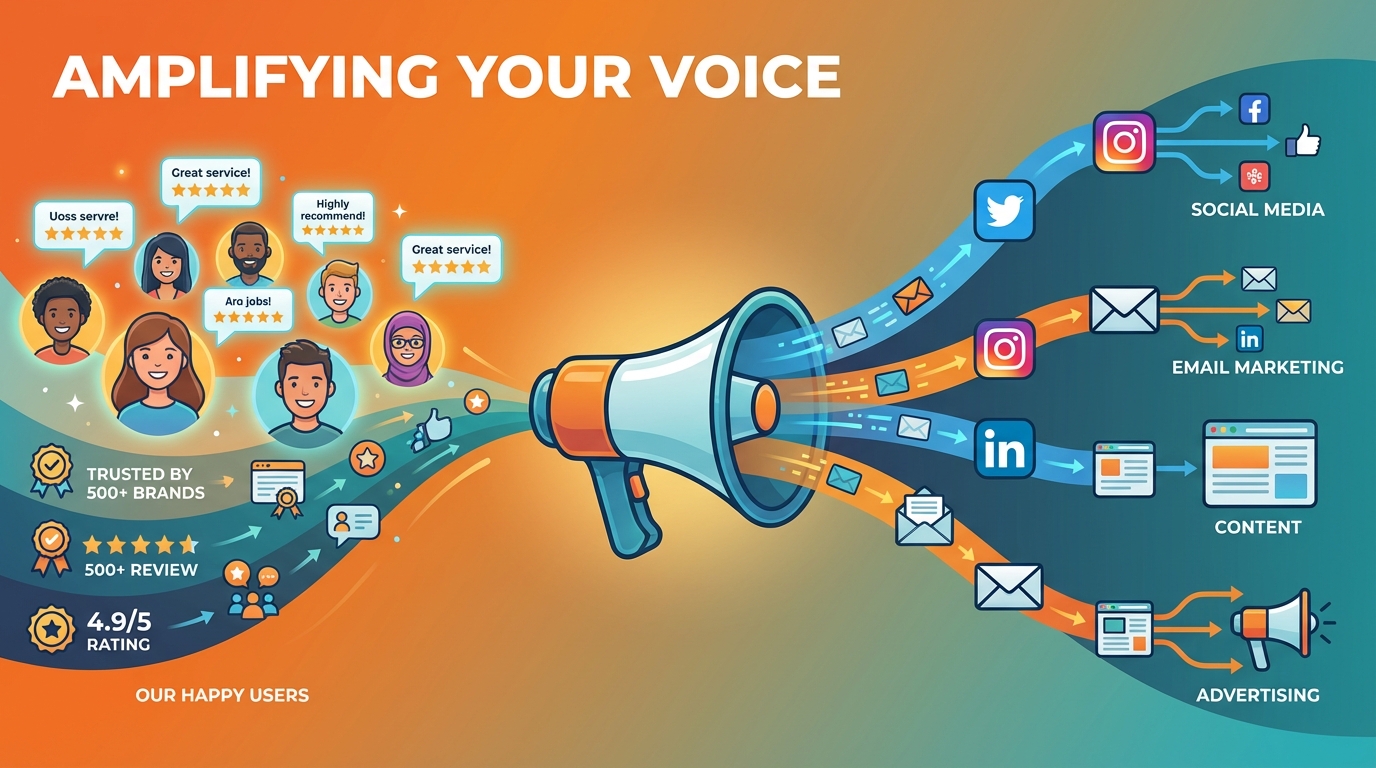
Distribute testimonials across channels:
- Email: Include in nurture sequences, newsletters
- Social: Quote graphics, video clips, customer spotlights
- Advertising: Testimonials in paid campaigns
- PR: Customer stories in press releases
- Events: Customer speakers, video loops
Review Sites
Proactively manage review presence:
- G2, Capterra, TrustRadius for B2B
- App stores for mobile products
- Google Business for local
- Industry-specific sites
Ask satisfied users to post reviews. Respond to all reviews, positive and negative.
Building Your Advocacy Program
Systematic programs outperform ad-hoc requests. Here's how to build one.
Program Components
Identification system:
- Advocacy scoring model
- Behavioral trigger detection
- AI-powered timing optimization
Request automation:
- Triggered outreach based on signals
- Multi-channel request delivery
- Follow-up sequence management
Collection infrastructure:
- Multiple submission formats
- Templates and examples
- Easy upload/recording tools
Management system:
- Testimonial library with tagging
- Approval workflows
- Expiration/refresh tracking
Distribution engine:
- Website integration
- Sales tool connections
- Marketing automation feeds
Metrics to Track
| Metric | Purpose | Target |
|---|---|---|
| Request rate | Coverage of potential advocates | 80% of high-score users |
| Response rate | Ask effectiveness | 25%+ |
| Completion rate | Friction level | 70%+ of responses |
| Quality score | Usefulness of content | 80%+ usable |
| Usage rate | Distribution effectiveness | Each testimonial used 5+ times |
| Refresh rate | Content freshness | < 25% over 18 months old |
Nurturing the Relationship
Advocacy is a relationship, not a transaction:
- Thank advocates personally
- Share how their testimonial performed
- Invite them to exclusive events or previews
- Recognize them in your community
- Check in periodically (without asking for more)
Treated well, advocates provide multiple testimonials over time and escalate their involvement.
Key Takeaways
-
Advocates are identified, not found: Use behavioral signals and AI to score advocacy potential and prioritize outreach.
-
Timing is everything: Ask immediately after positive experiences—goal achievement, support resolution, and milestone moments.
-
Frame as helping others: Position the request as sharing their success to help others facing similar challenges.
-
Reduce every friction point: Offer multiple formats, pre-populate content, and provide templates to maximize completion.
-
Create a testimonial ladder: Start with low-commitment options, then nurture advocates to higher-engagement formats over time.
-
Distribute systematically: A testimonial unused is wasted. Build systems to push social proof across every relevant touchpoint.
-
Treat advocacy as a relationship: Thank advocates, share results, and recognize their contribution to maintain long-term engagement.
User Vibes OS identifies your happiest users and automates advocate outreach. Learn more to turn satisfaction into growth.
Related Articles
Automated Testimonial Collection: Timing and Targeting
Systematically capture testimonials by reaching happy users at the right moment. Build a testimonial engine that runs on autopilot.
Product-Led Growth: Building Viral Loops Through User Feedback
Turn satisfied users into growth engines by integrating feedback loops that drive referrals, word-of-mouth, and organic expansion. PLG meets voice of customer.
Email Drip Campaigns Triggered by User Sentiment
Build smarter nurture sequences that respond to how users actually feel. Use sentiment signals to send the right email at the right moment.
Written by User Vibes OS Team
Published on January 10, 2026