Qualifying Leads with Smart Surveys: Beyond Demographics to Intent
Learn how AI-powered surveys segment users by problem urgency, budget, and fit. Feed better leads to sales and product teams with intelligent qualification.
Summary
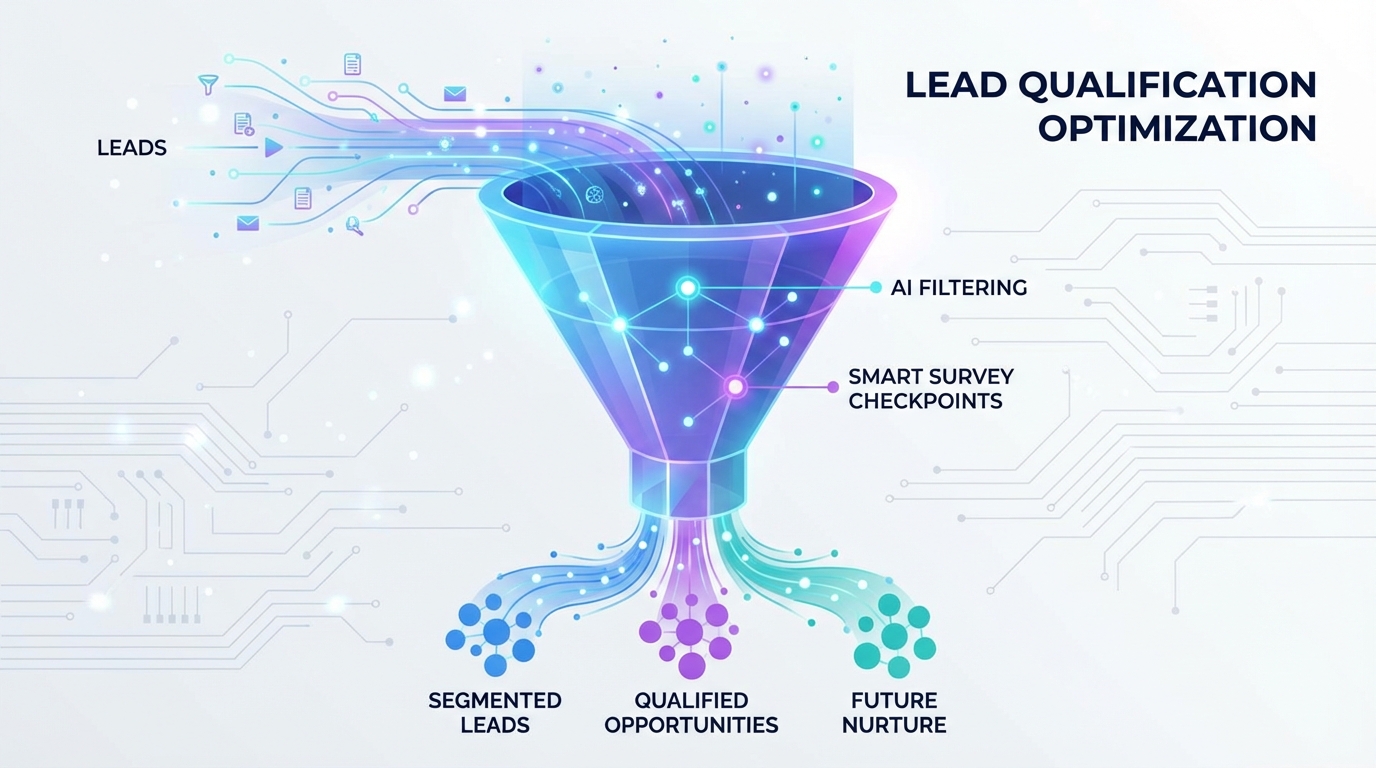
Traditional qualification focuses on demographics: company size, industry, job title. But demographics predict fit poorly. Smart surveys use AI to qualify based on what matters: problem urgency, readiness to act, budget availability, and use case alignment. This approach improves sales efficiency by 40% and reduces wasted time on poorly-qualified leads.
The Qualification Problem
Every company faces the same challenge: too many leads, not enough information to prioritize them. Sales wastes time on unqualified prospects. Marketing can't personalize without understanding needs. Product teams can't segment users without context.
Demographics Don't Predict Success
Traditional qualification scores on firmographics:
- Company size
- Industry
- Revenue
- Job title
- Geography
These predict general fit but miss what matters:
A "perfect fit" lead might be:
- Just researching, not buying
- Already committed to a competitor
- Lacking budget approval
- Solving a problem you don't address well
A "poor fit" lead might be:
- Desperately seeking a solution
- Budget approved and ready
- Perfect use case match
- Willing to grow into a larger customer
Demographic scoring treats these the same. Smart qualification doesn't.
The Cost of Poor Qualification
Poor qualification cascades through your organization:
| Impact Area | Consequence |
|---|---|
| Sales efficiency | Reps spend 70% of time on leads that won't close |
| Conversion rates | Pipeline full of unqualified opportunities |
| Forecasting | Revenue predictions unreliable |
| Customer success | Wrong-fit customers churn early |
| Product direction | Feedback from wrong audience |
Better qualification improves all of these.
The Four Pillars of Smart Qualification
Smart surveys assess four dimensions that demographics miss.
Pillar 1: Problem Urgency
How pressing is their need? Urgency predicts timeline and commitment.
Questions to assess urgency:
- "How long have you been looking for a solution?"
- "What happens if you don't solve this in the next 90 days?"
- "On a scale of 1-10, how urgent is this problem?"
- "What triggered you to start looking now?"
Urgency signals:
- Active search (high urgency)
- Recently assigned project (high)
- General research (low)
- No specific timeline (low)
Scoring example:
| Response | Score | Interpretation |
|---|---|---|
| "Our current solution is failing" | 10 | Crisis mode, will buy fast |
| "We have a new initiative starting" | 7 | Project-driven, moderate urgency |
| "Exploring options for next year" | 3 | Early research, long timeline |
| "Just curious about the space" | 1 | Not a lead yet |
Pillar 2: Readiness to Act
Can they actually buy? Authority, process, and timing matter.
Questions to assess readiness:
- "Are you the decision-maker for this purchase?"
- "Is there a budget allocated for this?"
- "Who else is involved in this decision?"
- "Have you evaluated other solutions?"
Readiness signals:
- Decision-maker with budget (high readiness)
- Evaluating final options (high)
- Building a business case (medium)
- No authority or budget (low)
The BANT+ Framework: Traditional BANT (Budget, Authority, Need, Timeline) enhanced with:
- Champion identification
- Evaluation stage
- Competitive consideration
- Internal sponsorship
Pillar 3: Use Case Alignment
Does what they need match what you offer? Misalignment creates churn.
Questions to assess alignment:
- "What's the primary problem you're trying to solve?"
- "What would success look like in 6 months?"
- "How are you currently handling this?"
- "What features are must-haves for your decision?"
Alignment scoring:
| Use Case Match | Score | Routing |
|---|---|---|
| Core product strength | 10 | Priority prospect |
| Supported but not ideal | 6 | Set expectations carefully |
| Edge case / workaround required | 3 | Evaluate fit honestly |
| Outside product scope | 0 | Disqualify gracefully |
Pillar 4: Value Potential
What's the opportunity worth? Not all qualified leads have equal value.
Questions to assess potential:
- "How many team members would use this?"
- "What's your current spend in this category?"
- "How does this fit into your broader stack?"
- "What growth do you expect in the next year?"
Value indicators:
- Team size and growth trajectory
- Current spend (indicates willingness to pay)
- Integration needs (stickiness)
- Expansion signals
Designing Smart Survey Flows
Structure matters as much as questions. AI enables dynamic, personalized flows.
Progressive Disclosure
Don't ask everything upfront. Start simple, go deeper based on responses.
Question 1: "What brings you here today?"
- Looking to buy soon → Continue to full qualification
- Just exploring → Light touch, nurture track
- Have a specific question → Route to resources or sales
If buying soon, Question 2: "What's the main problem you're solving?"
- [Problem A] → Branch A questions
- [Problem B] → Branch B questions
- Not sure yet → Discovery questions
Each path tailors subsequent questions to their context.
Conversational Qualification
AI enables qualification through conversation rather than forms:
AI: What brings you to UserVibes today?
User: We're drowning in support tickets and need to understand what customers actually want.
AI: Support volume is definitely a common challenge. Are you looking to reduce ticket volume, or better understand what the tickets reveal about your product?
User: Both, really. We're spending so much time answering the same questions.
AI: Got it—reducing repetitive tickets and extracting product insights. How large is your support team, and roughly how many tickets do you handle monthly?
User: Three people, about 500 tickets a month.
AI: That's a meaningful volume for a small team. Are you evaluating solutions now, or still understanding your options?
This conversation qualifies naturally while feeling helpful, not extractive.
Scoring and Routing
Based on responses, calculate a composite score:
Qualification Score =
  (Urgency × 0.25) +
  (Readiness × 0.30) +
  (Alignment × 0.30) +
  (Value × 0.15)
Route based on score:
| Score | Segment | Routing |
|---|---|---|
| 80+ | Hot | Immediate sales contact |
| 60-79 | Warm | Sales follow-up within 24h |
| 40-59 | Developing | Nurture sequence + SDR outreach |
| < 40 | Long-term | Marketing nurture only |
Self-Disqualification
Some leads aren't a fit. Let them discover this gracefully.
Question: "What's your budget range for a solution like this?"
- Options include one clearly below your minimum
- Selecting it triggers helpful guidance rather than sales pressure
Response to disqualified lead:
"Based on your budget, our full platform might not be the right fit right now. Here are some resources that might help, and we'll keep you updated as we introduce more flexible options."
This respects their time and leaves the door open without wasting yours.
AI Enhancement Strategies
AI transforms static surveys into intelligent qualification systems.
Dynamic Question Selection
AI selects next questions based on:
- Previous responses in this session
- Known information from other sources (CRM, website behavior)
- Patterns from similar leads
- Gap identification in qualification data
No two leads necessarily see the same questions.
Natural Language Understanding
Open-ended responses contain rich qualification data:
User response: "We're a fintech startup about to launch and need to collect beta feedback at scale."
AI extraction:
- Industry: Fintech
- Stage: Pre-launch startup
- Use case: Beta feedback collection
- Scale need: High volume
- Urgency: Implied (about to launch)
Structured data extracted without structured questions.
Predictive Qualification
AI predicts qualification scores based on partial information:
Available signals:
- Came from paid ad for "feedback tools"
- Viewed pricing page twice
- Company has 50 employees (from enrichment)
- Downloaded whitepaper on "reducing churn"
Predicted qualification: 72 (Warm) Confidence: Medium Recommended action: Ask about timeline and decision process to confirm
This enables intelligent routing even before survey completion.
Enrichment Integration
Combine survey responses with third-party data:
| Data Type | Source | Value |
|---|---|---|
| Firmographics | Clearbit, ZoomInfo | Company context |
| Tech stack | BuiltWith, Datanyze | Integration fit |
| Funding | Crunchbase | Growth trajectory |
| Intent signals | Bombora, G2 | Active evaluation |
Enrichment reduces questions needed while improving accuracy.
Measuring Qualification Quality
Track whether your qualification predicts outcomes.
Correlation Metrics
| Metric | What It Shows |
|---|---|
| Score → Close rate | Does high score predict winning? |
| Score → Deal size | Does value score predict ACV? |
| Score → Sales cycle | Does urgency predict timeline? |
| Score → Retention | Does alignment predict success? |
If correlations are weak, recalibrate your scoring model.
Efficiency Metrics
| Metric | Target | Why It Matters |
|---|---|---|
| Sales accepted rate | 70%+ | Are hot leads actually hot? |
| Time to qualification | < 5 minutes | Is the process efficient? |
| Completion rate | 60%+ | Is the survey too long? |
| Self-disqual rate | 10-20% | Are you attracting wrong audience? |
Feedback Loop
Sales and CS feedback improves qualification:
- Won deals: What did qualification miss that mattered?
- Lost deals: What should have been a warning sign?
- Churned customers: What alignment issues emerged?
Feed this back into scoring model updates quarterly.
Key Takeaways
-
Demographics predict fit poorly: Company size and title don't tell you urgency, readiness, alignment, or value. Smart qualification does.
-
Four pillars matter: Urgency (how pressing), readiness (can they act), alignment (do you fit), and value (opportunity size).
-
Progressive disclosure respects users: Start simple, branch based on responses. Don't ask everything upfront.
-
Conversational feels better than forms: AI-guided conversation extracts qualification data naturally while providing value.
-
Score and route automatically: Composite scores enable consistent, objective routing to the right team at the right time.
-
Let bad fits self-disqualify: Graceful disqualification respects everyone's time and leaves relationships intact.
-
Measure prediction accuracy: If qualification scores don't correlate with outcomes, recalibrate your model.
User Vibes OS uses AI-powered qualification to segment users before they become customers. Learn more to improve your pipeline quality.
Related Articles
Automated Testimonial Collection: Timing and Targeting
Systematically capture testimonials by reaching happy users at the right moment. Build a testimonial engine that runs on autopilot.
Exit Interviews That Actually Work: Recapturing Churned Users with AI
Learn why users leave, how to ask the right exit questions, and AI-powered strategies for win-back campaigns. Reduce churn by understanding it first.
Email Drip Campaigns Triggered by User Sentiment
Build smarter nurture sequences that respond to how users actually feel. Use sentiment signals to send the right email at the right moment.
Written by User Vibes OS Team
Published on January 10, 2026