The NPS Trap: Why Your Score Doesn't Predict Churn
NPS is overrated as a retention metric. Learn which leading indicators actually predict churn and how to build a composite customer health score.
Summary
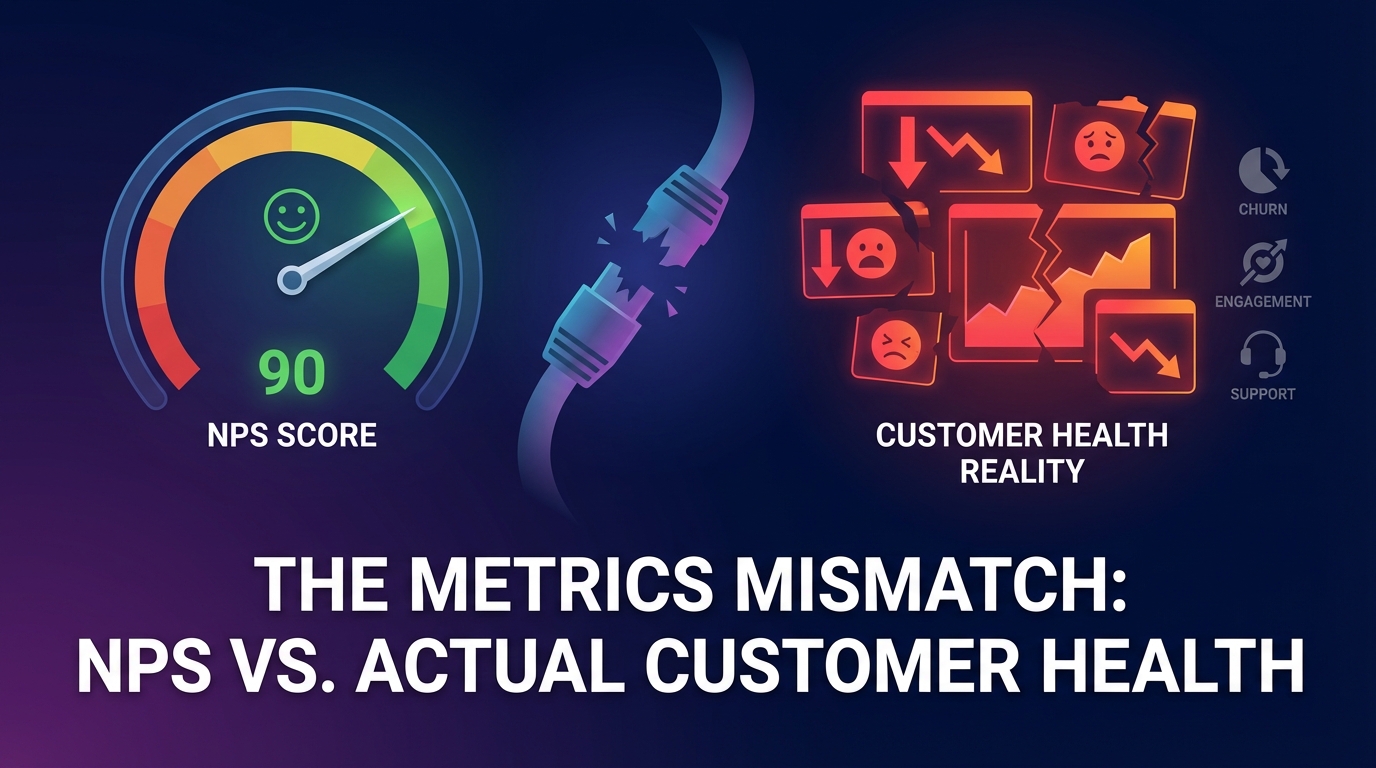
Net Promoter Score has become the default customer satisfaction metric, but it's a poor predictor of actual churn. Companies with high NPS scores still lose customers, while "detractors" often stay for years. This guide examines why NPS fails as a retention indicator and how to build composite health scores using behavioral signals that actually predict who will leave.
The NPS Obsession
Every SaaS company measures NPS. Board decks feature it. OKRs target it. Compensation ties to it. The premise is seductive: one number that captures customer sentiment and predicts business outcomes.
But the premise is flawed.
What NPS Actually Measures
NPS asks: "How likely are you to recommend us to a friend or colleague?"
This measures willingness to recommend—not satisfaction, not loyalty, not intent to renew. A user might love your product but never recommend it because:
- Their industry is competitive (they don't share advantages)
- The product is niche (no one to recommend to)
- They're private about their tools
- Recommending feels like extra work
Conversely, someone might recommend you freely while actively evaluating replacements.
The Research Problem
Multiple studies have failed to establish NPS as a reliable churn predictor:
| Study | Finding |
|---|---|
| Keiningham et al. (2007) | NPS no better than other satisfaction measures at predicting behavior |
| Morgan & Rego (2006) | Customer satisfaction indices outperformed NPS for business outcomes |
| Harvard Business Review (2019) | NPS explains only 25% of variance in customer behavior |
The "one number you need to know" isn't the number you need to know.
Why High NPS Customers Still Churn
Promoters (9-10 scores) churn for reasons NPS can't capture.
Circumstantial Changes
- Company acquired or merged
- Budget cuts across the board
- Key champion leaves the organization
- Strategic pivot away from your category
- Competitor offers irresistible switching deal
None of these scenarios show up in NPS. A promoter on Monday can be churned by Friday.
Unvoiced Friction
Users often don't connect daily frustrations to recommendation questions:
NPS survey: "Would you recommend us?" → "Sure, 9"
Daily reality: Slow exports, confusing settings, missing integrations
The recommendation question doesn't surface these issues. Users compartmentalize—they recommend the concept while suffering the execution.
The Switching Cost Illusion
High NPS might reflect high switching costs, not high satisfaction:
"I'd recommend you because there's no better option, but I'm not happy."
This "satisfied hostage" segment scores high but churns immediately when alternatives improve.
Why Detractors Stay Forever
The inverse is equally true. Users who score 0-6 often remain loyal customers.
The Complaining Loyalist
Some users complain because they care:
- They want the product to improve
- They're invested in your success
- Criticism is their form of engagement
These "detractors" often have higher lifetime value than silent promoters.
The Niche Dependency
Users in specialized workflows may have no alternatives:
- Your product is the only option in their niche
- Switching costs exceed dissatisfaction
- They've built years of data and workflows
They score low but renew without hesitation.
Survey Response Bias
Who responds to NPS surveys?
- People with strong opinions (both directions)
- People with time
- People who feel obligated
This creates a bimodal distribution that may not represent your actual customer base. The silent middle—often your most stable segment—is underrepresented.
Leading Indicators That Actually Predict Churn
Behavioral signals predict churn better than stated sentiment.
Engagement Decay
The most reliable churn predictor is declining engagement:
Churn Risk = f(
  Login frequency trend (30-day),
  Feature usage breadth change,
  Session duration trend,
  Key action completion rate
)
| Engagement Signal | High Risk | Medium Risk | Low Risk |
|---|---|---|---|
| Login frequency | Down 50%+ | Down 20-50% | Stable/Up |
| Features used | Declining | Stable | Expanding |
| Session duration | < 2 min avg | 2-10 min | > 10 min |
| Key actions/week | Down 40%+ | Down 10-40% | Stable/Up |
Engagement decay often begins 60-90 days before cancellation—plenty of time to intervene.
Support Pattern Changes
Support interactions reveal health:
Positive signals:
- Feature questions (exploring value)
- Integration requests (embedding deeper)
- Training requests (investing in adoption)
Negative signals:
- Repeated issues unresolved
- Escalation requests
- Billing/contract questions
- Export/data access requests (preparing to leave)
Product-Specific Milestones
Define milestones that indicate value realization:
| Product Type | Value Milestone | Churn Risk If Missing |
|---|---|---|
| Analytics | First dashboard created | High if not by day 14 |
| Collaboration | Second team member added | High if solo after 30 days |
| Automation | First automation deployed | High if not by day 21 |
| CRM | 100 contacts imported | Medium if under 50 |
Users who hit milestones retain at 3-5x the rate of those who don't.
Expansion Signals (or Lack Thereof)
Healthy customers grow:
- Adding users
- Upgrading plans
- Purchasing add-ons
- Increasing usage volume
Stagnation—especially in accounts with growth capacity—signals satisfaction plateau or silent dissatisfaction.
Building a Composite Health Score
Combine multiple signals into a single health metric that outperforms NPS.
Health Score Components
Health Score =
  (Engagement Score × 0.35) +
  (Adoption Score × 0.25) +
  (Support Score × 0.15) +
  (Growth Score × 0.15) +
  (Sentiment Score × 0.10)
Note: Sentiment (including NPS) contributes only 10%. Behavior dominates.
Engagement Score (0-100)
Based on login frequency, session depth, and feature usage relative to their segment's baseline.
const engagementScore = calculateEngagement({
  loginFrequency: user.logins30Day / segmentAverage.logins30Day,
  sessionDepth: user.avgSessionDuration / segmentAverage.avgSessionDuration,
  featureUsage: user.featuresUsed / totalFeatures,
  trend: user.engagement30Day / user.engagement60Day, // >1 = improving
});
Adoption Score (0-100)
Based on milestone completion and feature adoption breadth.
| Milestone | Points | Maximum |
|---|---|---|
| Onboarding complete | 20 | 20 |
| Core feature used | 5 each | 30 |
| Integration connected | 10 each | 20 |
| Team member added | 5 each | 15 |
| Advanced feature used | 5 each | 15 |
Support Score (0-100)
Based on support interaction patterns.
const supportScore = 100 - (
  (unresolvedTickets × 10) +
  (escalations × 15) +
  (repeatIssues × 10) +
  (billingInquiries × 20)
) + (
  (featureQuestions × 5) +
  (trainingRequests × 5)
);
Growth Score (0-100)
Based on expansion velocity relative to potential.
const growthScore = calculateGrowth({
  userGrowth: currentUsers / usersAtStart,
  usageGrowth: currentUsage / usageAtStart,
  planUpgrades: hasUpgraded ? 20 : 0,
  expansionPotential: currentUsers / potentialUsers, // vs. their org size
});
Interpreting Health Scores
| Score Range | Status | Action |
|---|---|---|
| 80-100 | Healthy | Advocacy opportunities |
| 60-79 | Stable | Monitor for decline |
| 40-59 | At Risk | Proactive outreach |
| 0-39 | Critical | Immediate intervention |
Operationalizing Health-Based Retention
Scores only matter if they drive action.
Automated Triggers
Configure actions based on health changes:
Score drops below 60:
- Alert CSM
- Trigger check-in email
- Add to at-risk dashboard
Score drops 20+ points in 30 days:
- Immediate CSM outreach
- Executive sponsor notification
- Renewal risk flag in CRM
Score rises above 80:
- Testimonial request trigger
- Upsell opportunity flag
- Referral program invitation
Segmented Interventions
Different risk profiles need different interventions:
| Risk Profile | Root Cause | Intervention |
|---|---|---|
| Engagement decay | Value unclear | Success call, use case review |
| Adoption stall | Complexity | Training, guided setup |
| Support issues | Product friction | Engineering escalation |
| Growth stagnation | Satisfied but not expanding | Business review, expansion discussion |
Feedback Integration
Use health scores to trigger targeted feedback collection:
At-risk accounts: "We noticed you haven't logged in recently. Is everything okay?"
Declining adoption: "You haven't tried [feature] yet. What would make it useful for you?"
Critical scores: Skip surveys, go direct with human outreach.
When NPS Still Matters
NPS isn't useless—just overweighted. Use it appropriately.
Benchmarking
NPS enables comparison:
- Against your historical scores
- Against industry benchmarks
- Across customer segments
Trends in NPS reveal macro shifts even if absolute scores don't predict individual churn.
Qualitative Feedback
The most valuable part of NPS is the follow-up question:
"What's the primary reason for your score?"
This open text—not the number—provides actionable insights.
Marketing and Social Proof
High NPS makes good marketing:
- "Our customers rate us 72 NPS"
- Proof point for prospects
- Validation for stakeholders
Just don't confuse marketing utility with retention prediction.
Key Takeaways
-
NPS measures recommendation intent, not loyalty: Willingness to recommend correlates weakly with actual retention behavior.
-
Promoters churn, detractors stay: Circumstances, switching costs, and unvoiced friction create disconnects between scores and outcomes.
-
Behavioral signals outperform sentiment: Engagement decay, support patterns, and milestone completion predict churn 60-90 days before it happens.
-
Build composite health scores: Weight engagement (35%), adoption (25%), support (15%), growth (15%), and sentiment (10%) for predictive accuracy.
-
Automate triggers on health changes: Score drops should activate CSM outreach, intervention playbooks, and executive awareness.
-
Use NPS for benchmarking and qualitative feedback: The number enables comparison; the follow-up question provides insight.
-
Stop tying compensation to NPS alone: Incentivize health scores and actual retention, not survey responses.
User Vibes OS combines behavioral analytics with AI-powered feedback to create health scores that actually predict retention. Learn more.
Related Articles
Exit Interviews That Actually Work: Recapturing Churned Users with AI
Learn why users leave, how to ask the right exit questions, and AI-powered strategies for win-back campaigns. Reduce churn by understanding it first.
Automated Testimonial Collection: Timing and Targeting
Systematically capture testimonials by reaching happy users at the right moment. Build a testimonial engine that runs on autopilot.
Email Drip Campaigns Triggered by User Sentiment
Build smarter nurture sequences that respond to how users actually feel. Use sentiment signals to send the right email at the right moment.
Written by User Vibes OS Team
Published on January 12, 2026